In this lesson, we will learn about Broker Commission Markups by using the Fee Per Trade Unit method.
The Fee Per Trade Unit method enables brokers to charge clients based on a fee per share, per contract, or a percentage of the trade value. This method is highly configurable, allowing adjustments for each asset class, exchange, and currency. The unit for calculating the fee (per share, per contract, or percentage of trade value) is determined by the asset class and currency, in alignment with Interactive Brokers’ (IBKR) commission schedule.
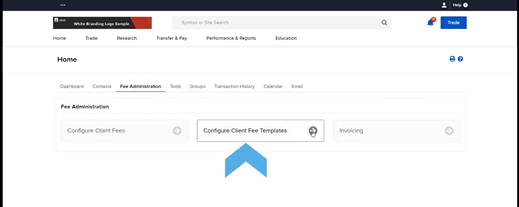
To set up a Fee Per Trade Unit template, brokers should go to the Fee Administration tab in the Broker Portal and select Client Fee Templates. A new template can be created by clicking the plus sign in the top right corner and naming the template. For the examples discussed, the Fixed Pricing structure is used as the Fee Strategy, meaning IBKR’s Fixed Pricing schedule serves as the base for markup calculations.
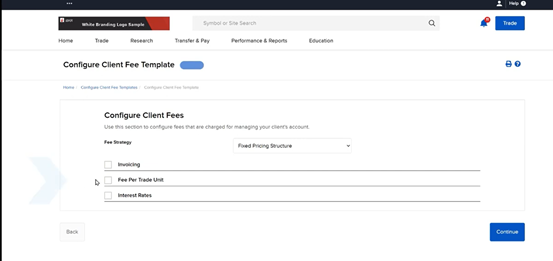
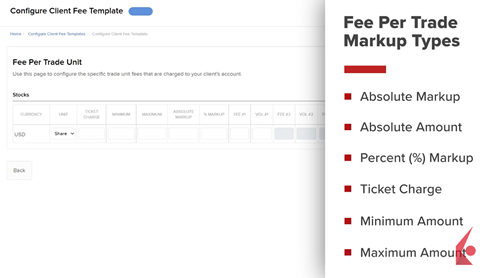
Upon selecting Fee Per Trade Unit, a list of available asset classes appears, ready for configuration. Although the lesson’s example focuses on USD stocks, brokers can configure multiple asset classes and currencies simultaneously. For each combination of asset class and currency, brokers can choose from several markup types, including Absolute Markup, Absolute Amount, Percent (%) Markup, Ticket Charge, Minimum Amount, and Maximum Amount.
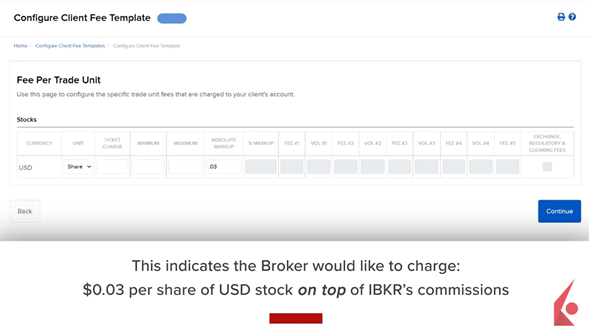
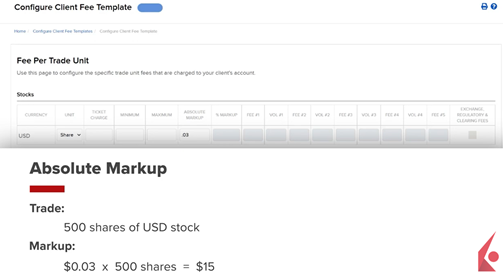
Absolute Markup is a specific additional amount over IBKR commissions, and the applicable unit (per share, per contract, or percentage of notional trade value) is specified in the Currency/Exchange/Product Unit column. Absolute Markup values can be precise to three decimal places. For instance, if a broker sets an Absolute Markup of $0.03 per share for USD stocks, a client trading 500 shares would incur a markup of $15, resulting in a total charge of $17.50, which includes the IBKR commission of $2.50.
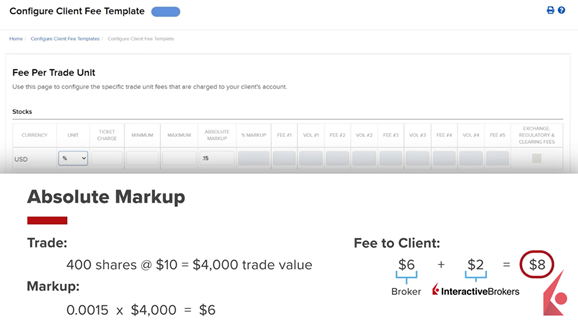
If the broker selects a percentage in the Unit column, the markup is calculated as a percentage of the trade value. For example, an Absolute Markup of 0.15% for USD stocks would mean a trade of 400 shares at $10 each (totaling $4,000) incurs a markup of $6. Thus, the total charge would be $8, comprising $6 as broker markup and $2 as IBKR commission.
When an Absolute Markup value is entered, the % Markup and Absolute Amount fields become inactive because a single asset cannot use both Absolute Markup and either % Markup or Absolute Amount methods simultaneously. However, the Ticket Charge, Minimum, and Maximum fields remain configurable and are addressed later in the video.
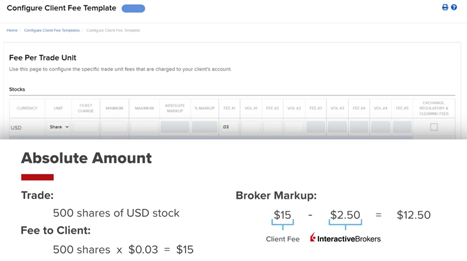
Absolute Amount is the per trade amount charged to the client, from which IBKR’s commissions are subtracted. Unlike Absolute Markup, which adds to IBKR’s commissions, the Absolute Amount includes IBKR’s commissions, requiring the broker’s specified value to exceed IBKR’s commission for profitability. Brokers can use Fee and Volume columns to set multiple tiers based on trade volume. For instance, if a broker sets a fee of $0.03 per share for USD stocks, a trade of 500 shares would result in a $15 charge, from which $2.50 would go to IBKR, leaving $12.50 for the broker.
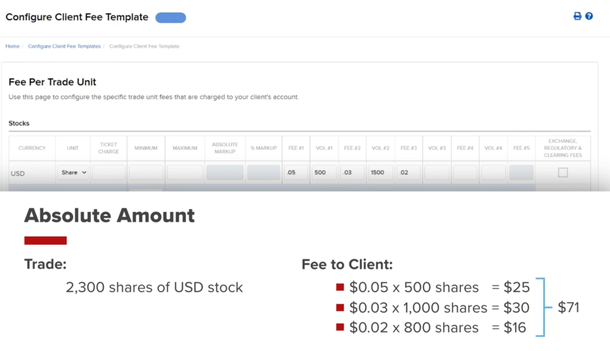
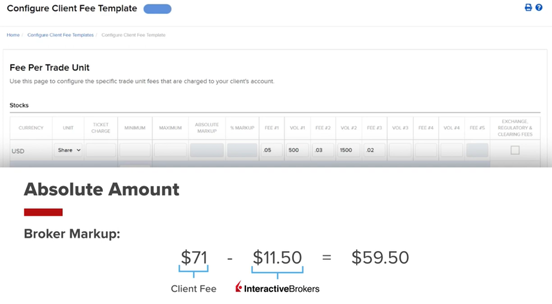
Absolute Amount allows tiered pricing based on trade volume. For example, a broker might charge $0.05 per share for the first 500 shares, $0.03 for the next 1,000 shares, and $0.02 for shares above 1,500. A 2,300-share trade would then be charged $71 in total, with $11.50 going to IBKR, resulting in $59.50 for the broker. Brokers can also pass exchange and regulatory fees to the client if Absolute Amount is configured, by selecting the relevant option.
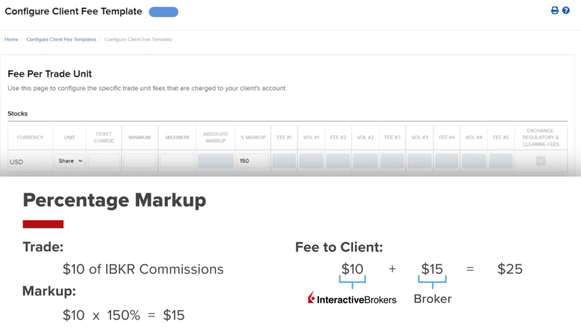
Percentage Markup enables brokers to charge a percentage of IBKR’s standard commission per trade. For instance, a 150% markup on IBKR’s $10 commission results in a $15 broker fee, making the total client charge $25.
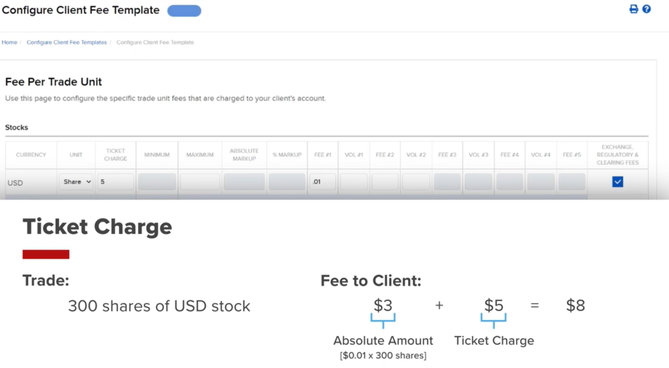
Ticket Charge is an additional flat fee per trade that brokers can use alongside other pricing methods such as Absolute Markup, Absolute Amount, or Percentage Markup. For example, a $5 Ticket Charge plus an Absolute Amount markup of $0.01 per share on a 300-share trade would result in a total charge of $8.
Minimum Amount ensures a minimum charge per trade. If a broker sets a $10 minimum with an Absolute Amount markup of $0.03 per share, a 200-share trade would be charged $10 instead of the $6 calculated fee. However, a 600-share trade would be charged $18, as this exceeds the minimum. There are limits on the minimum amount, and brokers cannot specify both a minimum amount and a ticket charge for the same asset class or currency.
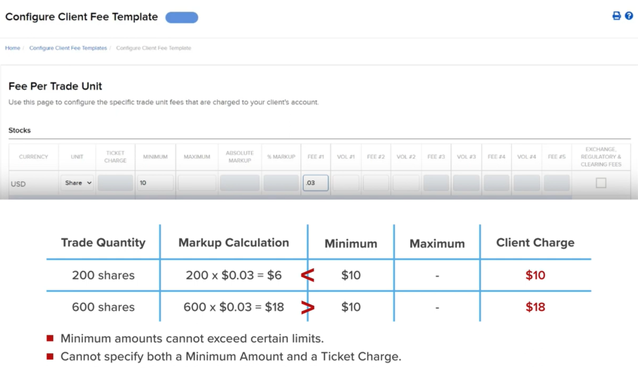
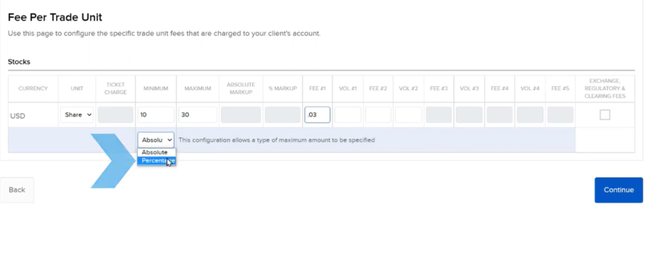
In the Maximum amount, brokers can set a maximum limit for the amount charged per trade, ensuring that clients do not exceed this specified fee. For example, a broker might set a maximum charge of $30 for USD stock trades. If a client places a trade for 600 shares, they would be charged $18 (calculated as 600 shares multiplied by $0.03 per share). This amount is within the range defined by the minimum and maximum limits—between $10 and $30 in this case.
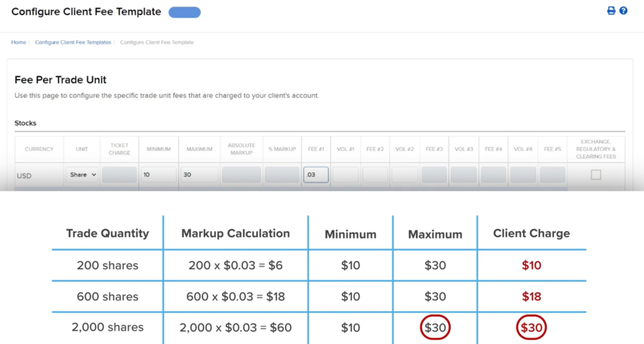
However, if the same client trades 2,000 shares, the fee would be capped at $30, even though the calculated fee at the same rate ($0.03 per share) would be $60. This cap protects clients from excessive charges on large trades. Additionally, for certain currencies like the USD, the maximum charge can be set as a percentage of the trade value instead of a fixed dollar amount. This option can be selected in the designated drop-down menu. Various methods, as demonstrated in instructional videos, allow brokers to configure these markups effectively, ensuring a balance between fair charges and profitability.